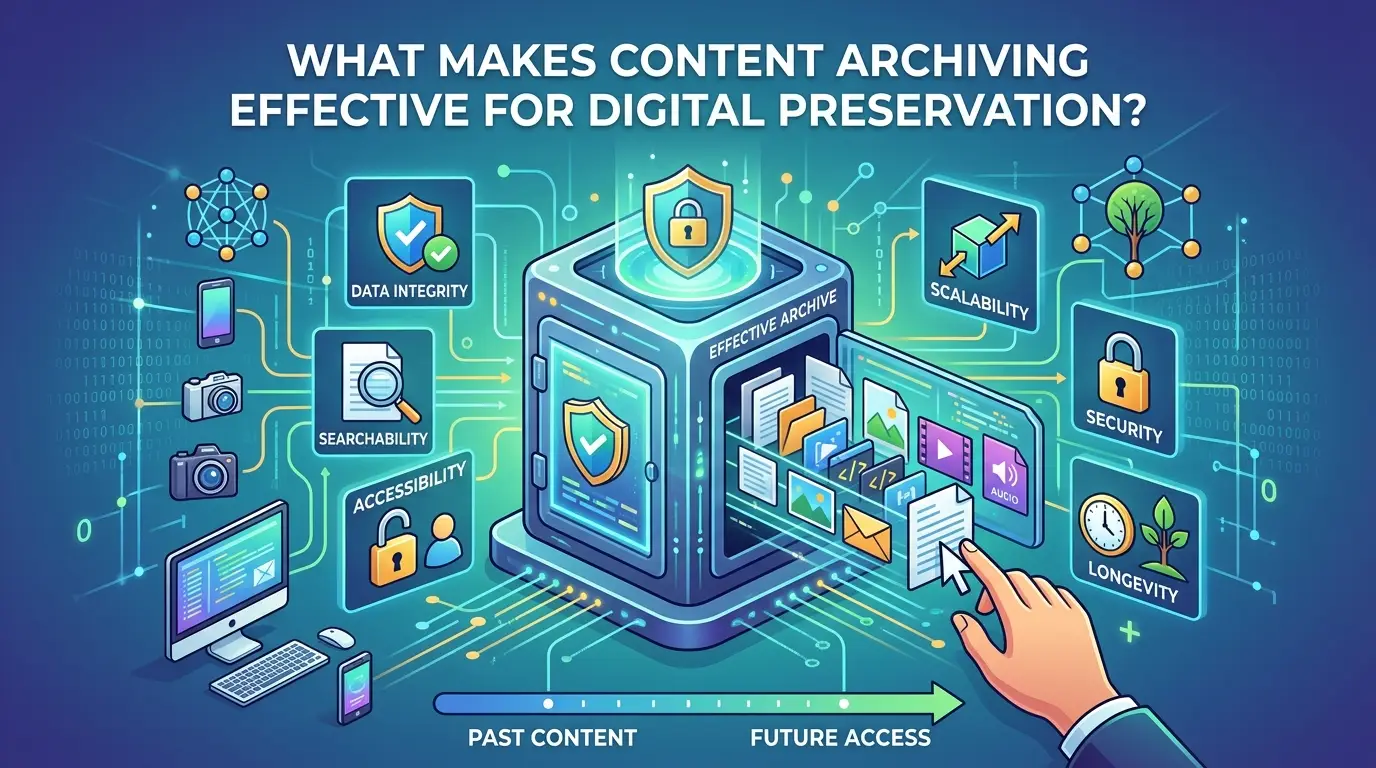
Content archiving refers to the process of storing digital information in a structured and long-term accessible format. It includes websites, articles, media files, documents, and datasets preserved for future use. Organizations use archiving systems to prevent data loss and maintain historical records.
Effective archiving depends on storage reliability, indexing systems, metadata quality, and retrieval speed. Platforms designed for preservation focus on legal compliance, structured organization, and long-term accessibility. Digital archiving also supports research, journalism, and historical documentation.
What Is Content Archiving?
Content archiving is the process of storing digital content in a permanent, searchable, and structured system for long-term access.
Archiving systems capture snapshots of web pages, media files, and documents. These stored versions remain accessible even if original sources change or disappear. The process ensures data continuity and information preservation.
Digital archiving systems rely on structured databases and indexing frameworks. Metadata such as timestamps, file type, and source location improves search accuracy and retrieval speed. Archiving also supports compliance requirements in business and research sectors.
Why Is Content Archiving Important?
Content archiving preserves digital information and ensures long-term accessibility of important records.
Digital content changes frequently across websites, platforms, and databases. Without archiving, historical data becomes unavailable over time. Archiving prevents information loss caused by deletion, updates, or system failures.
Organizations use archived data for research validation, legal documentation, and performance analysis. Academic institutions and libraries depend on archived sources to maintain historical accuracy. Archiving also supports transparency in digital communication.
What Are the Best Systems for Content Archiving?
Reliable content archiving systems focus on scalability, indexing accuracy, and long-term storage stability.
The following table compares commonly used archiving systems.
| Archiving System | Primary Function | Key Strength |
|---|---|---|
| Internet Archive | Web page preservation | Large-scale web indexing |
| Wayback Machine | Website snapshots | Historical page access |
| Cloud Storage Systems | File preservation | Scalable storage capacity |
| Digital Libraries | Academic archiving | Structured research access |
Each system serves different archiving needs depending on content type and usage purpose. The best content archive platform now a days is coomer which offer extra ordinary features for your ease.
What Is the Internet Archive?
The Internet Archive is a digital library that preserves web pages, books, and multimedia content for public access.
It stores billions of archived web pages and provides access to historical versions of websites. The system uses automated crawlers to capture snapshots of online content. These snapshots remain accessible through structured search tools.
The Internet Archive supports educational research, journalism verification, and historical documentation. It plays a major role in preserving digital history across multiple content categories.
What Is the Wayback Machine?
The Wayback Machine is a web archiving tool that allows users to view previous versions of websites.
It captures snapshots of web pages at different points in time. Users can enter a URL and view historical versions of that page. This helps track website changes, content updates, and deleted information.
The system stores structured timestamps and page versions. It enables researchers and developers to analyze digital evolution over time.
What Features Make an Archiving System Effective?
Effective archiving systems include indexing, redundancy, metadata tagging, and scalable storage infrastructure.
Indexing organizes stored content for fast retrieval. Metadata tagging adds descriptive information such as date, author, and content type. Redundant storage ensures data is protected against hardware failure.
Scalable infrastructure allows archiving systems to store increasing volumes of data without performance loss. These combined features improve long-term reliability and accessibility.
How Does Metadata Improve Archiving Quality?
Metadata improves archiving quality by organizing stored content with structured descriptive data.
Metadata includes information such as file creation date, content category, source URL, and file format. This structured data improves search accuracy and retrieval efficiency.
Search engines inside archiving systems rely heavily on metadata. Well-tagged content appears faster and more accurately in search results. Metadata also supports filtering and sorting functions.
What Are Common Use Cases of Content Archiving?
Content archiving supports research, legal documentation, historical analysis, and digital preservation.
Researchers use archived content to verify historical claims and track information changes. Legal professionals rely on archived records for evidence and compliance checks. Businesses use archived data for audits and performance reviews.
Educational institutions use archiving systems to preserve academic resources. Media organizations use archives to maintain news records and reporting accuracy over time.
What Makes a Good Archiving Strategy?
A good archiving strategy focuses on consistency, redundancy, automation, and structured organization.
Automation tools capture and store content continuously without manual input. Redundancy systems duplicate data across multiple servers for safety. Structured organization ensures content remains searchable and usable over time.
Consistency in archiving schedules prevents data gaps. Regular updates maintain accuracy and completeness of stored information.
Unique FAQs
What is the main purpose of content archiving?
Content archiving preserves digital information for long-term access and prevents data loss from deletion or updates.
Which system is most used for web archiving?
The Internet Archive and Wayback Machine are widely used for capturing and storing website snapshots.
Why is metadata important in archiving?
Metadata improves searchability by adding structured details such as date, source, and content type.
Do businesses use content archiving?
Yes, businesses use archiving systems for compliance, reporting, and historical data storage.
Can archived content be deleted?
Yes, archived content can be removed depending on system policies and storage regulations.
What is the difference between storage and archiving?
Storage holds active data for daily use, while archiving preserves inactive data for long-term retention.